How to configure MFA Policy
Since version 3.10.0, Passbolt Pro Edition supports MFA Policy.
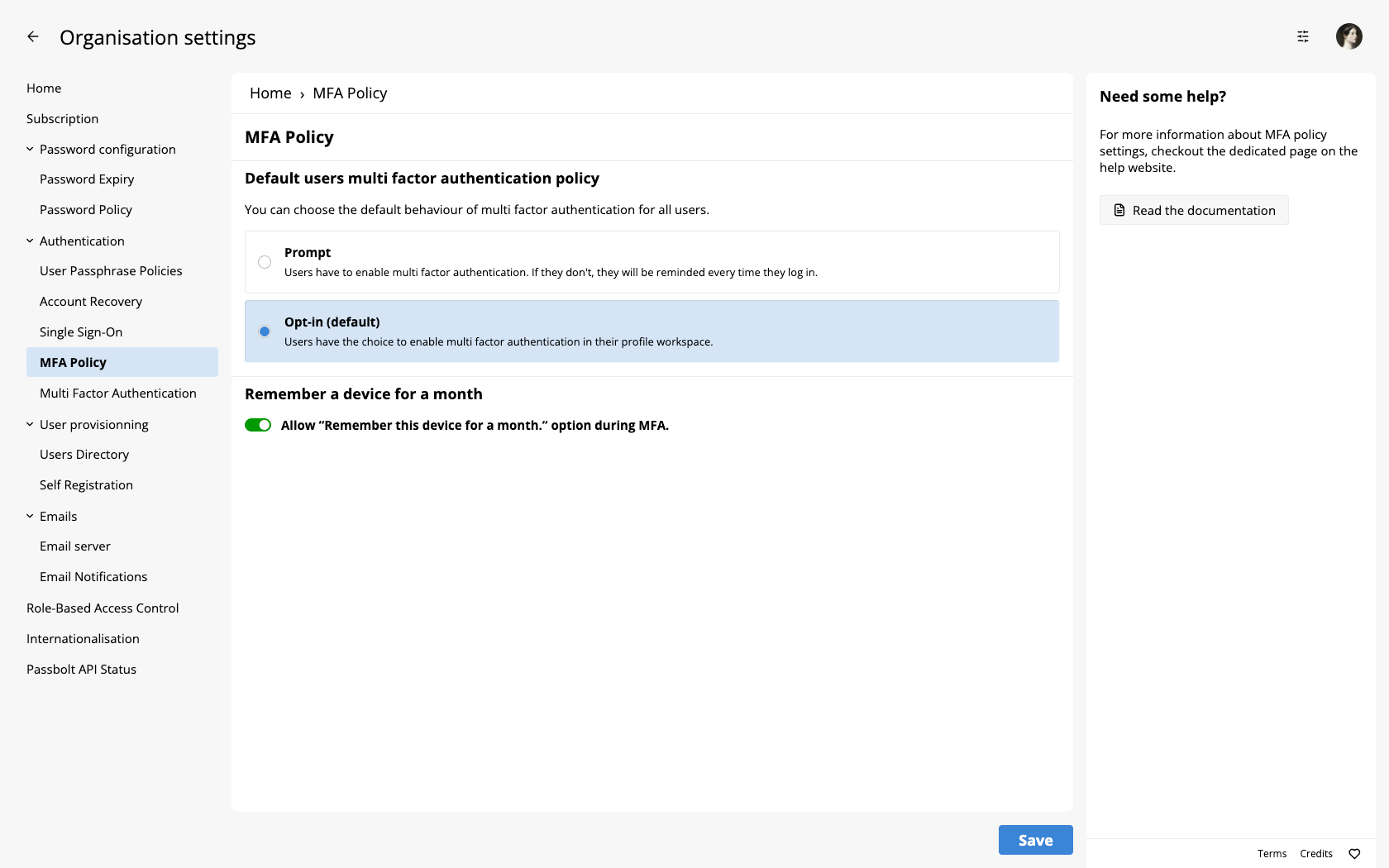
Define the default multi factor authentication policy
Administrators are now able to set the default behaviour of the multi factor authentication for all their users.
Passbolt is already using Multi-Factor Authentication by default, because you have to provide the recovery kit which is the private key and you have to know the passphrase associated to it. It means that you have the knowledge factor which is the passphrase and you have the possession factor which is the private key. With any Multi-Factor Authenticator configured, it is adding another good layer of security.
The screen holds two settings. If you drive them through the API, mind that the interface labels and the stored values differ:
| Setting in the interface | API field | Values | Default |
|---|---|---|---|
| Prompt, Opt-in | policy | mandatory, opt-in | opt-in |
| Allow "Remember this device for a month." option during MFA. | remember_me_for_a_month | true, false | true |
The "Prompt" option is stored as mandatory. Despite that name, it does not make multi factor authentication mandatory to sign in, see below.
Prompt
Stored as policy: mandatory.
passbolt reminds users to configure multi factor authentication, it does not force them to. A user who has no method configured gets a dialog titled "Enable Multi Factor Authentication", with two ways out: "Go to MFA settings", which opens their profile settings, and "Later". Postponing dismisses the invitation for the current session, and it comes back at the next sign-in.
Prompt does not block sign-in and does not restrict access: a user can postpone the invitation indefinitely, one session at a time. It is an interface reminder, so it has no effect on API clients such as scripts or the command line interface. To require multi factor authentication for authentication itself, configure it at the provider level.
Opt-in (default)
Stored as policy: opt-in, the value that applies when no policy has been saved.
This will give the opportunity to the users to enable or not the multi-factor authentication. They will not be reminded after that.
Remember the device for a month
With this option, administrators are able to allow users to remember their device for a month after successfully logging in with their multi factor authentication. The checkbox is labelled Allow "Remember this device for a month." option during MFA., it is stored as remember_me_for_a_month, it is enabled by default, and the duration is exactly 30 days.
Unlike the policy above, this setting is enforced by the server. Clearing it does not only hide the option from the verification screen, it also invalidates the devices that were already remembered, so the users concerned are asked for their second factor again at their next verification.